
Main Risks in Forklift Operating Areas
Reviewing OSHA's published summaries of individual forklift-related fatality investigations shows recurring patterns: a raised load blocking the operator's forward view, pedestrians not being noticed in time, and tip-overs during sharp turns or excessive speed [1]. NIOSH's alert on preventing injuries and deaths among forklift operators and nearby workers similarly highlights overturns, struck-by, and crushed-by events as the dominant fatality patterns [2]. These recurring patterns form the practical starting point for any discussion of forklift safety technology.
- Blocked forward view — a loaded forklift, particularly during reversing or in narrow aisles, restricts the operator's field of view.
- Mixed pedestrian-vehicle traffic and reversing — routes shared by personnel and forklifts increase the value of early-warning mechanisms; EU-OSHA notes that reversing manoeuvres account for nearly a quarter of all work-related vehicle deaths [3].
- Delayed reaction — in a visibility-restricted environment, a hazard noticed late leaves less time for braking or maneuvering.
How Do AI-Powered Camera Systems Work?
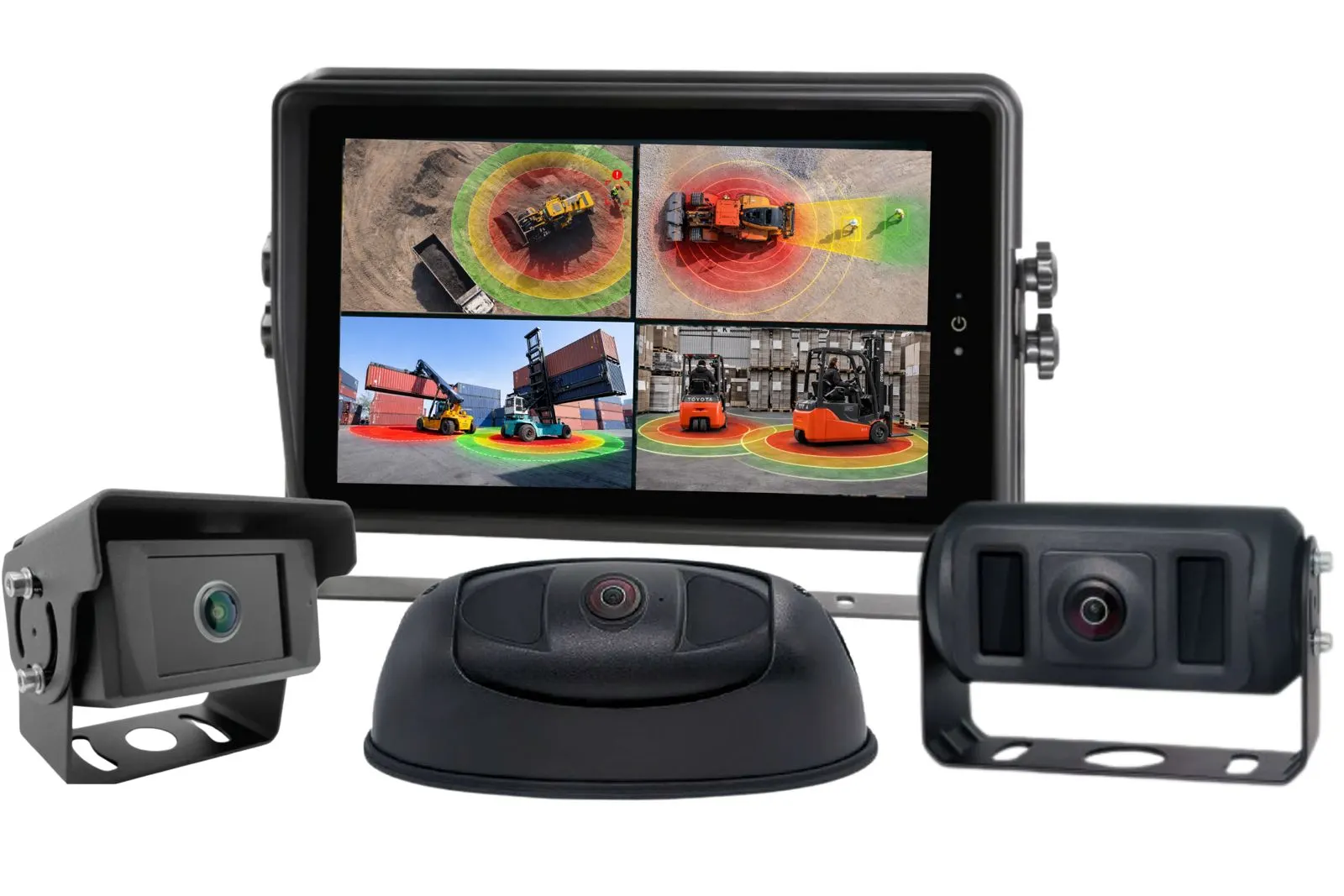
These systems process the video feed from one or more vehicle-mounted cameras in real time, using a trained model to classify objects in the surrounding area. Unlike a simple motion sensor, the goal is to distinguish between a person, another vehicle, and a static obstacle, and to react differently to each.
Processing typically happens on a compute unit mounted on the vehicle itself (edge processing) rather than sending video to a remote server, since the reaction needs to happen within a very short window for it to be useful to the operator.
Detecting People, Vehicles, and Danger Zones
The classification model generally distinguishes between three categories: people, vehicles or equipment, and static obstacles. Each category can be configured to trigger a different response — for example, a person entering a defined zone may trigger a more urgent alert than another vehicle passing at a safe distance.
The "danger zone" concept refers to a virtual boundary defined around the vehicle. In many systems this boundary is not fixed — it can expand at higher speed and contract at lower speed, since stopping distance changes accordingly.
False Alarms and Site Conditions
Dust, rain, strong reflections, and narrow warehouse aisles can all affect detection accuracy, leading to either excessive false alerts or missed detections. A system that is not calibrated to actual site conditions risks being ignored by operators over time if it alerts too often without cause.
For this reason, an on-site test period under real operating conditions — not just a vendor demonstration — is a reasonable step before full deployment.
Technical Criteria to Evaluate When Choosing a System
Marketing material rarely gives a full picture. The criteria below are what actually determine whether a system performs reliably in a specific facility.
Camera Field of View
The horizontal and vertical angle the camera actually covers determines how much of the blind spot is addressed. A wide angle can reduce distortion at the edges of the frame, which affects how reliably distant objects are classified.
Detection Range
The distance at which a person or vehicle can be reliably detected should be evaluated against the vehicle's typical operating speed in that facility, not just as an abstract number.
Response Latency
The time between an object entering the danger zone and the alert reaching the operator is critical. A system that is otherwise accurate but slow to alert provides limited practical safety margin at typical forklift speeds.
Low-Light and Night Performance
Many facilities operate in mixed lighting — bright loading docks, dim storage aisles, outdoor yards at dusk. Detection accuracy in low light should be evaluated separately from daytime performance, not assumed to be equivalent.
Ingress Protection (IP) Rating
Camera and sensor housings intended for industrial and outdoor use are commonly rated under IEC 60529, which defines protection against solid particles with a first digit from 0 to 6, and against liquids with a second digit from 0 to 9 [4]. A higher rating on both digits generally indicates greater resistance to dust and moisture exposure, which is relevant in yards, ports, and unconditioned warehouse space.
| Criterion | What it affects |
|---|---|
| Field of view | How much of the blind spot is actually covered |
| Detection range | Available reaction time relative to vehicle speed |
| Response latency | Practical safety margin between detection and alert |
| Low-light performance | Reliability during dusk, indoor shade, or night shifts |
| IP rating (IEC 60529) | Durability against dust and moisture in the operating environment |
Integration and Warning Mechanisms
Detection alone has limited value without a clear way to alert the operator — typically an audible signal, an on-screen indicator, or a combination of both. Where a facility already runs a fleet management or telemetry system, the ability to log alerts centrally can support later review of recurring risk areas rather than relying on the operator's memory alone.
Site Assessment Before Deployment
Before selecting a specific model, it helps to map the facility: aisle widths, typical vehicle speeds, pedestrian traffic patterns, and lighting conditions across shifts. This assessment determines which of the criteria above matter most for that specific site, rather than defaulting to the highest specification on paper.
Conclusion
AI-powered detection cameras do not remove the need for safe operating procedures, but they add a layer of awareness in exactly the situations where human attention is most likely to fail — a blocked view, a fast-moving cross-aisle, a dim corner. Selecting a system based on field of view, range, latency, low-light performance, and IP rating, tested under real site conditions, is what separates a meaningful safety investment from a checkbox purchase.
Sources
- U.S. Occupational Safety and Health Administration (OSHA) — Summaries of Selected Forklift Fatalities Investigated by OSHA
- National Institute for Occupational Safety and Health (NIOSH / CDC) — Preventing Injuries and Deaths of Workers Who Operate or Work Near Forklifts (Pub. No. 2001-109)
- European Agency for Safety and Health at Work (EU-OSHA) — Workplace Transport — Vehicle Safety e-Guide
- International Electrotechnical Commission (IEC) — IP Ratings — Degrees of Protection (IEC 60529)
As the solution partner for AI-based camera detection systems in Turkey, Arles supports facilities through site assessment, system selection, and integration for AI camera detection systems.